Staple fiber: cut lengths, spun into yarn
Staple fiber is produced as continuous filament straight off the spinning line, then mechanically cut into short, discrete lengths, typically 32 to 150 millimetres for PET and PP, or 51 to 120 millimetres for PA. Those cut lengths cannot be used directly as yarn; they must go through a separate spinning process (ring spinning, open-end spinning, or air-jet spinning) that twists many individual fibers together into a continuous, cohesive yarn strand, or through a carding and bonding process to form a nonwoven web.
Cut length is chosen to match the intended process: cotton-system spinning mills typically want shorter cut lengths compatible with their drafting rollers, while nonwoven carding lines and filling applications use their own characteristic length ranges. Crimp is added to staple fiber specifically to give it the cohesion and bulk needed to card, draft or loft correctly, since a straight, uncrimped cut fiber has poor fiber-to-fiber grip. Cut length and crimp are specified alongside dtex on every genuine staple fiber spec sheet.
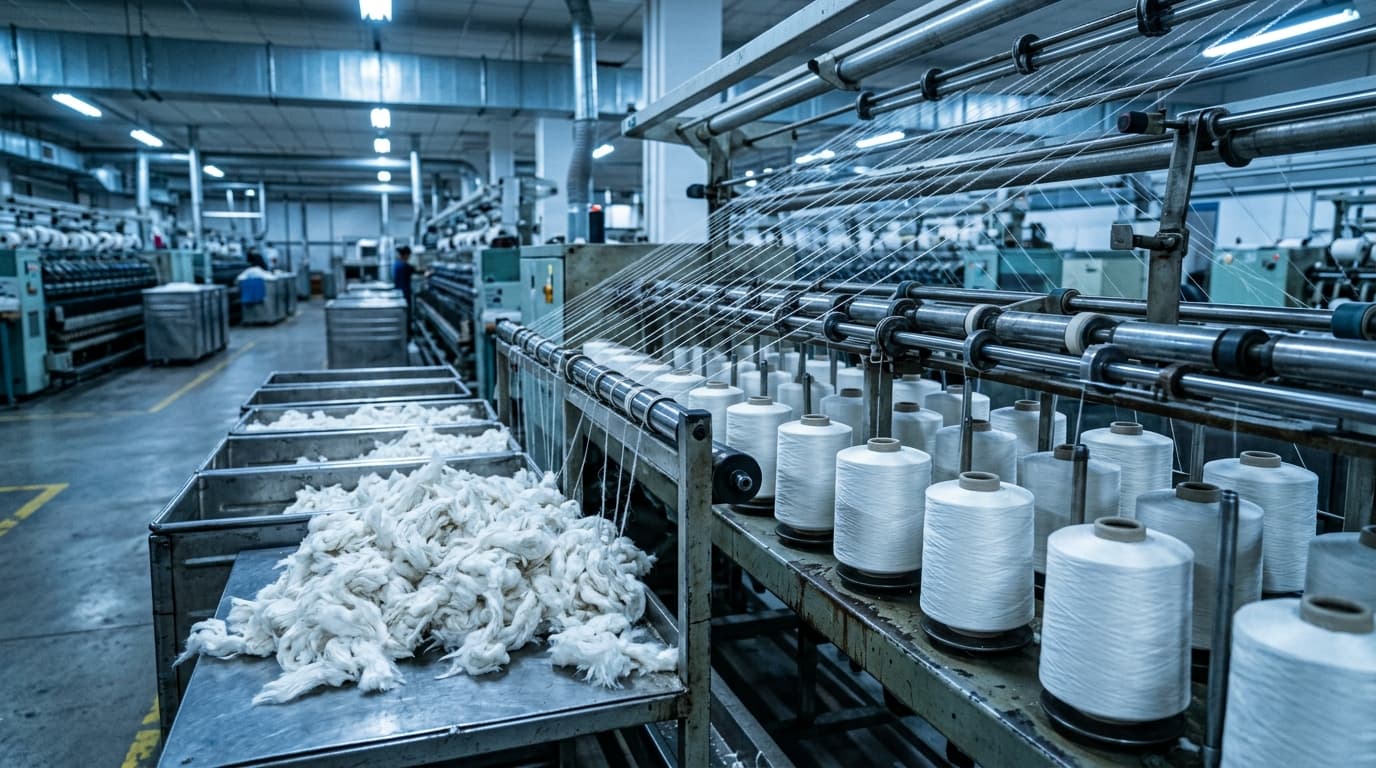
Filament yarn: continuous, ready to use
Filament yarn is composed of continuous strands that are never cut. Multiple continuous filaments are combined (and often twisted or textured) directly off the spinning line into a finished yarn package, ready for weaving, knitting or direct use in technical applications, with no separate spinning-mill step required. This is why filament yarn is sometimes described as a "ready-made" yarn form compared to staple fiber, which is an intermediate material that still needs converting.
Because there is no fiber-to-fiber slippage point along a continuous filament, filament yarn generally achieves higher tenacity for a given denier than an equivalent spun staple yarn, and it typically has a smoother, more uniform surface, which matters for applications like technical webbing, industrial belting and fine woven or knitted fabric.
Side-by-side comparison
| Factor | Staple fiber | Filament yarn |
|---|---|---|
| Physical form | Cut lengths (32–150mm typical) | Continuous, uncut strand |
| Needs further processing | Yes: spinning or carding | No: ready to weave, knit or use directly |
| Typical tenacity for given denier | Lower (twist-dependent) | Higher (no slippage points) |
| Typical buyers | Spinning mills, nonwoven and filling manufacturers | Weaving/knitting mills, technical textile and industrial converters |
| Available on FiberTrade for | PET, PP, PA | PET, PA (technical filament yarn) |
What to check before buying either form
For staple fiber, confirm dtex, cut length, crimp and profile (solid or hollow) against your specific line requirements; see our dtex guide for how linear density drives fit. For filament yarn, confirm total denier, filament count (the number of individual continuous filaments bundled into the yarn), twist level, and tenacity, since these determine how the yarn will behave in weaving, knitting or technical end use.
Both forms should carry origin flagging (virgin, semi-virgin or regenerated) and, where applicable, GRS certification for recycled content, exactly as with staple fiber. The physical form changes the process it fits; it does not change the need for verified specification and certification data attached to the listing. Both forms are available on FiberTrade across PET, PP and PA.