What dtex actually measures
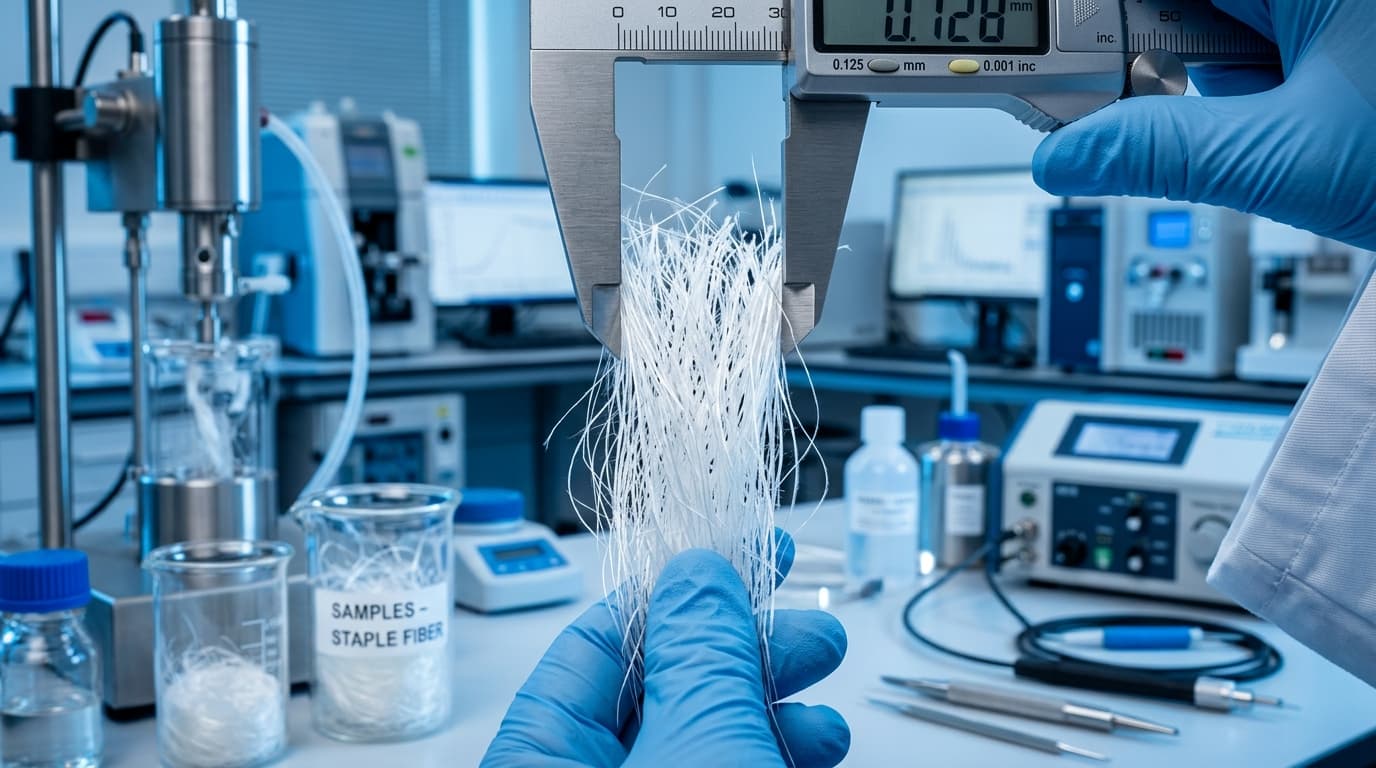
Dtex, short for decitex, is a unit of linear density: the mass, in grams, of 10,000 metres of a single fiber filament. It is not a measure of diameter, and it is not a measure of strength on its own. It is simply weight per unit length, and it is the standard way the global fiber industry specifies how fine or coarse a fiber is.
A 1.4 dtex fiber weighs 1.4 grams for every 10,000 metres of continuous length. A 17 dtex fiber, common in geotextile and technical applications, weighs more than ten times as much per unit length and is correspondingly thicker and coarser to the touch. The lower the dtex number, the finer the fiber; the higher the number, the coarser it is.
Because dtex is a ratio of mass to length rather than a physical measurement of diameter, it does not vary with polymer density the way a direct diameter measurement would. This is exactly why the textile and technical fiber industries adopted it as the standard unit: it lets buyers compare fiber fineness across different polymer types, including PET, PP and PA, on a consistent basis.
Dtex vs denier: the conversion
Denier is an older, related unit still used widely in North America and in some technical and carpet-fiber specifications. Denier is defined as the mass in grams of 9,000 metres of fiber, rather than 10,000 metres. The conversion between the two is fixed and simple:
| To convert | Formula | Example |
|---|---|---|
| Denier to dtex | dtex = denier × 1.111 | 1.5 denier ≈ 1.67 dtex |
| Dtex to denier | denier = dtex × 0.9 | 1.67 dtex ≈ 1.5 denier |
Because the two units differ by a fixed ratio (10,000 metres versus 9,000 metres of reference length), any spec sheet quoted in denier can be converted to dtex with a single multiplication, and vice versa. When comparing quotes from different suppliers, always confirm which unit is being used: a supplier quoting "1.5" without specifying dtex or denier is leaving real ambiguity on the table.
Typical dtex ranges by application
Different end uses call for very different linear densities. As a general reference across PET, PP and PA staple fiber:
| Application | Typical dtex range | Why |
|---|---|---|
| Hygiene / lightweight nonwoven | 1.2–2.2 dtex | Fine fiber gives softness and low basis weight for diapers, wipes and medical nonwovens. |
| Spinning (staple to yarn) | 1.3–3.3 dtex | Fine, consistent fiber spins cleanly into yarn with fewer breaks on ring or open-end frames. |
| Filling / hometextile | 4–15 dtex | Coarser hollow-profile fiber gives loft and resilience for pillows and duvets without matting. |
| Nonwoven (structural, filtration) | 3.3–6.7 dtex | Mid-range dtex balances strength, air permeability and processability on carding lines. |
| Geotextile / technical | 6–28 dtex | Coarse, high-tenacity fiber is needed for soil stabilization, drainage and industrial felts. |
| Carpet (PA staple) | 15–22 dtex | Coarse fiber gives the bulk, resilience and abrasion resistance carpet pile requires. |
Why dtex matters more than most buyers expect
Dtex determines how a fiber will behave through every downstream process. On a spinning frame, fiber that is too coarse for the intended yarn count will not draft evenly and will produce an uneven, weak yarn. On a nonwoven carding line, fiber that is too fine for the target basis weight will not open and card cleanly, leading to neps and uneven web formation. In filling applications, fiber that is too fine will mat down and lose loft after a handful of wash cycles.
Dtex also interacts with cut length and crimp. A given dtex fiber cut too long for the processing equipment will tangle; cut too short, it will fly and generate excessive waste. Crimp frequency and amplitude are usually tuned to a specific dtex range to give the right bulk without over-compacting. This is why a genuine spec on FiberTrade always lists dtex alongside cut length, profile and crimp, rather than dtex in isolation.
When comparing suppliers, always confirm the dtex is a controlled specification with a stated tolerance (commonly ±5 to ±10 percent for staple fiber), not just a nominal target. Variation outside tolerance is one of the most common causes of processing complaints in the staple fiber trade, and it is exactly the kind of detail that gets lost when fiber is described only as "polyester fiber" rather than specified by dtex, cut length and profile.
Dtex is also independent of fiber origin: virgin, semi-virgin and regenerated grades are all specified and traded by the same dtex ranges, though origin can affect how tight a dtex tolerance is achievable in practice. See our virgin vs semi-virgin vs regenerated fiber guide for how origin affects achievable spec range, and our staple fiber vs filament yarn guide for how dtex applies differently once fiber is spun into yarn.