Virgin fiber
Virgin fiber is produced entirely from newly polymerized resin: PET, PP or PA that has never been through a prior use cycle or reprocessing step. Because the polymer chain has not been degraded by a previous melt cycle, virgin resin offers the most predictable and widest achievable range of intrinsic viscosity, molecular weight distribution and melt flow, which translates directly into the widest range of specifiable fiber properties: finer achievable dtex, higher achievable tenacity, and the tightest lot-to-lot consistency.
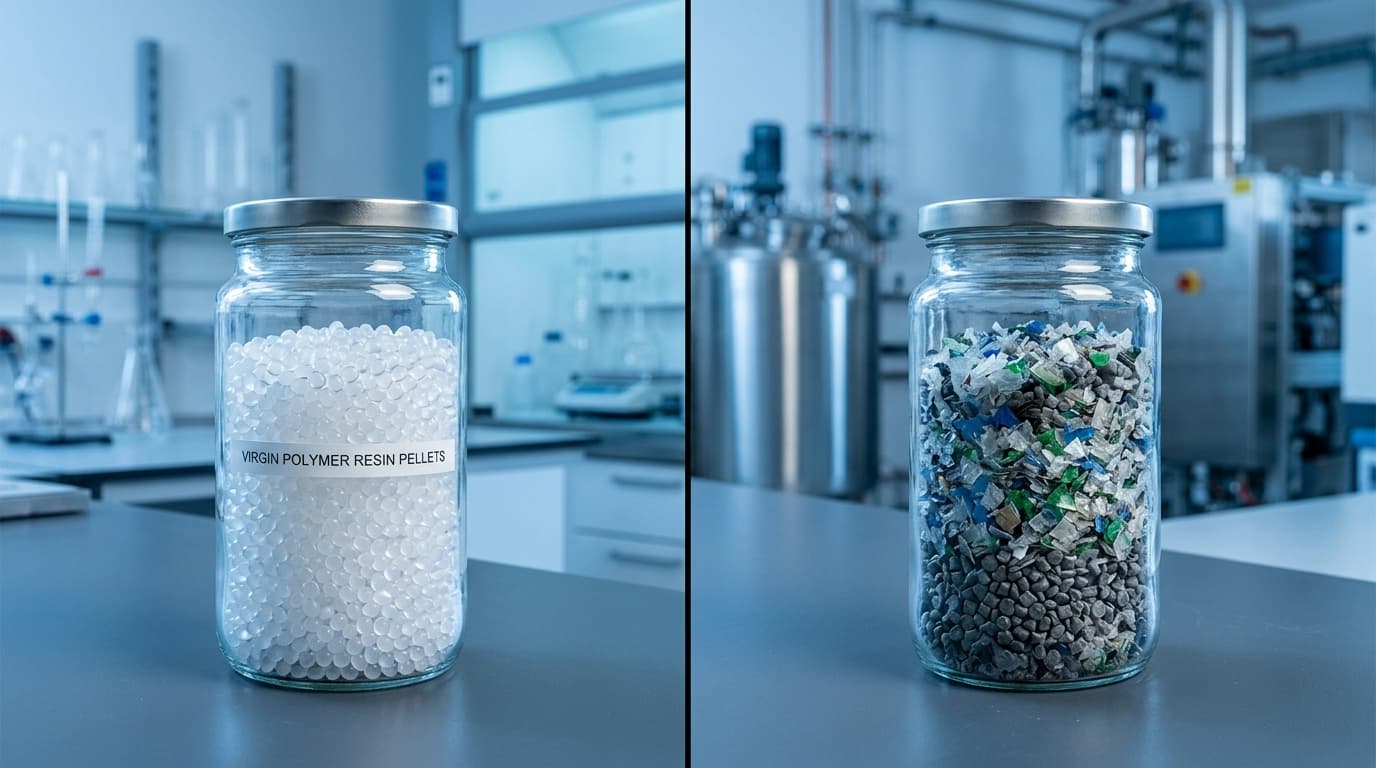
Virgin fiber is the default choice for technical and high-performance applications, such as high-tenacity industrial yarn, fine hygiene-grade nonwoven fiber, and any application where consistent, guaranteed physical properties matter more than input cost or recycled-content credentials.
Semi-virgin fiber
Semi-virgin fiber is produced from a blend of virgin resin and recycled or reprocessed input, most commonly post-industrial material such as polymerization byproduct, edge trim from film or fiber production, or off-spec resin that did not meet virgin-grade tolerances but is chemically clean and well-characterized. This is distinct from post-consumer regenerated fiber, since the input has typically never left the industrial supply chain.
Because the recycled fraction in semi-virgin fiber is post-industrial rather than post-consumer, it generally carries less contamination risk and less intrinsic viscosity variation than post-consumer recycled input, allowing semi-virgin grades to sit closer to virgin fiber on consistency while offering a modest cost and sustainability advantage. Semi-virgin fiber typically does not qualify for GRS certification unless the post-industrial content meets GRS's recycled-input definitions, so buyers should confirm certification status rather than assume it from the "semi-virgin" label alone.
Regenerated fiber
Regenerated fiber is made from recycled input that has been mechanically or chemically reprocessed back into fiber-grade polymer. For PET, this is overwhelmingly post-consumer bottle waste, sorted, washed, flaked and either directly melt-spun (mechanical recycling) or depolymerized and re-polymerized (chemical recycling) before being spun into fiber. For PP, input is more commonly post-industrial and post-consumer packaging waste.
Mechanically recycled regenerated fiber can match virgin fiber closely on many physical specs, particularly for mid-range dtex nonwoven and filling applications, but the recycled input carries more inherent intrinsic-viscosity and color variation than virgin resin, which narrows the achievable range for very fine dtex or very high-tenacity technical grades. Chemically recycled (depolymerized) regenerated fiber can approach virgin-equivalent consistency at a higher production cost.
Genuine regenerated fiber grades carry GRS certification with a Transaction Certificate verifying the recycled content and chain of custody; see our GRS certification guide for how that verification actually works.
Choosing between them
| Factor | Virgin | Semi-virgin | Regenerated |
|---|---|---|---|
| Input source | New polymer only | Virgin blended with post-industrial | Post-consumer / post-industrial recycled |
| Consistency | Highest | High | Good, wider tolerance typical |
| Achievable dtex range | Widest, finest available | Wide | Narrower at the fine end |
| Typical certification | None required | Case by case | GRS with Transaction Certificate |
| Best fit | Technical, high-tenacity, fine nonwoven | Cost-sensitive general nonwoven, filling | Sustainability-driven programs, general nonwoven, filling |
On FiberTrade, every listing states its origin (virgin, semi-virgin or regenerated) explicitly, and the Fiber Finder lets buyers filter by origin alongside dtex, cut length and profile, so origin is never a guessing game buried in a data sheet.